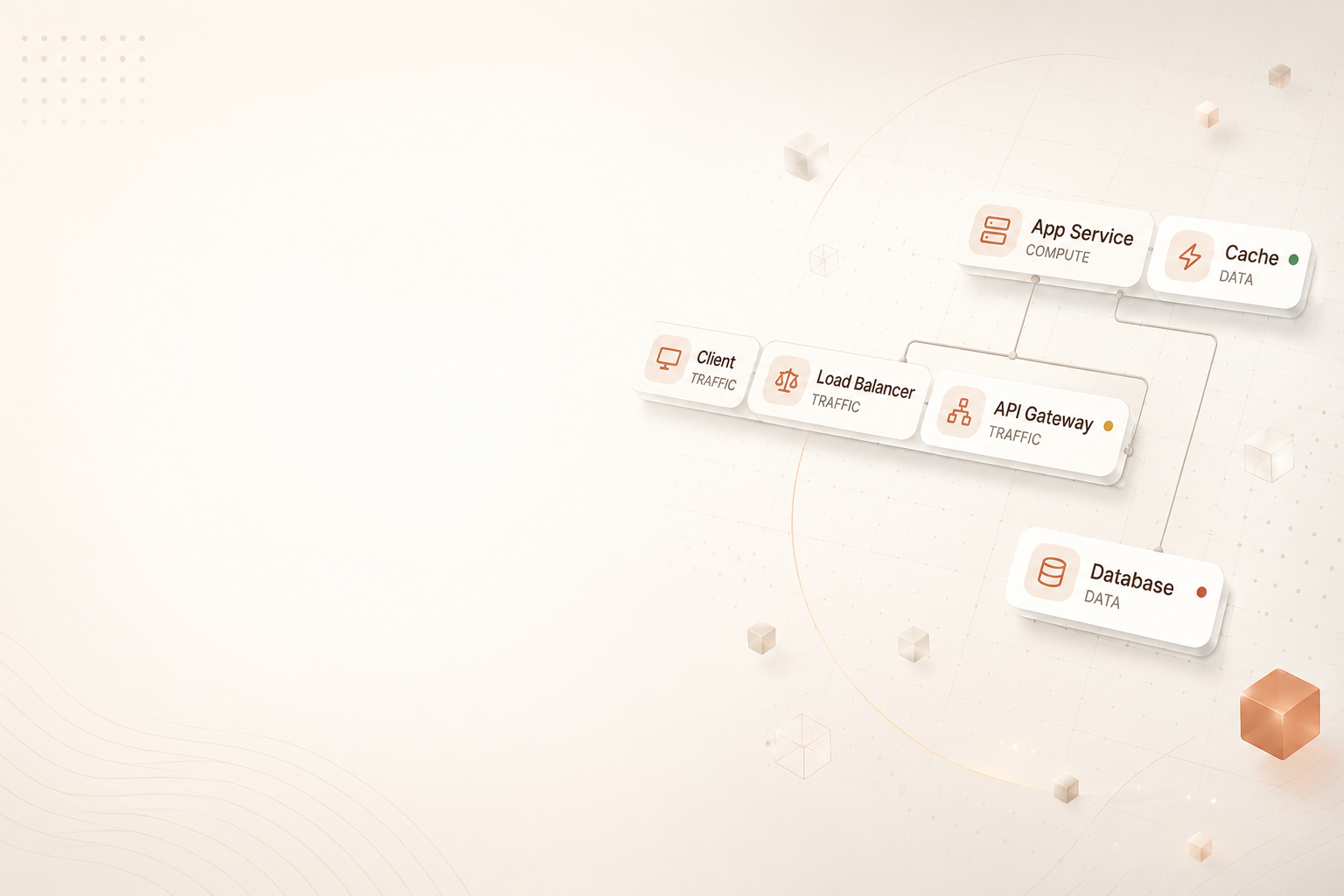
Design systems that scale.Architect better.
Visualize distributed systems, collaborate in real time, simulate load, detect bottlenecks, and generate production-ready architecture documentation.
- Real-time collaboration
- Load simulation
- Architecture reviews
- Open source
Three real engines, one calm canvas.
ArchForge isn't a diagram-drawing toy. Under the canvas sit a discrete-event simulator, a graph-based review engine, and a design-doc generator — all running locally.
Visual architecture canvas
Drag, drop, and connect 20 real distributed-system components. A calm, infinite canvas with auto-layout, multi-select, and an inspector for every node.
Discrete-event load simulator
Push real traffic through your design. A seeded event-driven engine reports p50/p95/p99 latency, utilization, queue depth, drops, and cascading failures.
Deterministic review engine
Sixteen graph-based rules flag single points of failure, exposed databases, missing caches, and scaling risks — reachability and articulation points, not guesswork.
Design-doc generation
Turn any diagram into a production-ready system-design document. Every section is computed from your actual topology and traffic — no lorem, no AI filler.
Real-time collaboration
Design together. Yjs CRDTs sync over WebSockets with live cursors and selections — multiplayer architecture without a dedicated realtime backend.
Local-first & open source
Runs entirely in your browser, localStorage-first and offline-friendly. No accounts, no paywalls. Optional cloud save and share when you want it.
From blank canvas to design doc in three moves.
Model
Drop components onto the canvas and connect them. Set capacity, risk, and metadata per node — or start from a real-world template.
Simulate
Dial in DAU, payloads, and read/write ratios. Run the simulator and watch tail latency climb and queues saturate as you approach capacity.
Review & export
Get prioritized warnings with suggested fixes, then export a complete Markdown design doc — or share a live session with your team.
Start from a real system.
Eight reference architectures, each with traffic assumptions, scaling notes, and known bottlenecks baked in.
The hard parts are real math, not a language model.
Discrete-event simulation
A seeded event loop with a min-heap queue, per-node bounded queues and parallel servers, retries, and failure injection — M/M/c queueing behaviour you can verify against theory.
Graph-based review
Client-reachability, adjacency, and articulation-point analysis drive sixteen deterministic rules. Same diagram in, same findings out — every time.
CRDT collaboration
Yjs documents synchronized over a self-hosted WebSocket server with the y-protocols sync/awareness handshake — conflict-free, no dedicated realtime service.
Open the canvas and start building.
ArchForge is free, open source, and MIT licensed. No account required — your work stays in your browser until you choose to share it.